There are certain moments in life when you know you have “arrived”. This piece is about one of them. I’ve gone from not attending any political meetings, to attending two in one day!
I’ll cover:
- A meeting organised by Scottish ADHD Coalition, to work with other neurodivergent organisations
- Glaswegian hustings, organised by Scottish Autism, with regards to the upcoming local elections
- Hidden bonuses of meetings
- An elephant in the room
Part of this is for my local friends in Scotland, but there are some wider points/reminders made.
One should not apologise for things outside of one’s control – as I shall highlight later. So this is NOT an apology, as per my first instinct, but a warningthat this is a relatively rushed piece of reportage for reasons of time. Feel free to ask questions in the comments if you want any clarifications or to point out bits that don’t make sense. I’ve decided to get something out, for insight, rather than wait for the perfect moment, which apparently [checks notes] is unlikely to arrive.
Scottish ADHD Coalition meeting with partner organisations
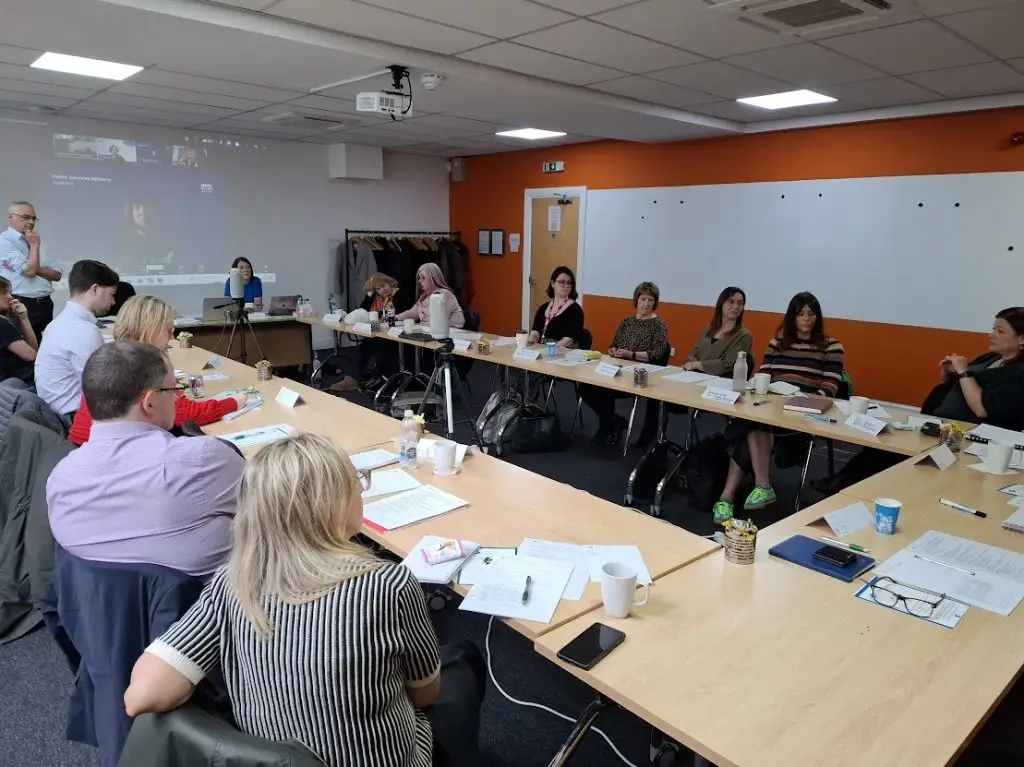
We’ve been working in silos.Often the Coalition has been invited to the Scottish Parliament to present and answer committee questions, along with other organisations representing neurodivergent people. We’ve literally been in the same building, but usually in different rooms. The brainchild of Bill Colley, the Coalition’s chair, this is the first time we’ve truly sat down to speak to one another as a group (rather than having individual conversations on the sidelines). Some things are really obvious in hindsight!
Here are some personal reflections.
1. Priorities. Every organisation has their own hobby horse on how to achieve things. Whether it’s lived experience, data or policy. In my opinion, the grim truth is that none of us has managed to shift the dial. All of us have made tiny bits of progress, but it’s been distributed so thin that there has been no disconcernable impact overall. Too much time spent reinventing the wheel, amongst other issues. For my money, we should choose one tactic, produce some results, and then we have the evidence base to move on to new areas for improvement. Writing this, occasionally I wonder how many other lessons can I transfer from my previous IT/Salesforce world?! 🤯
The equivalent metaphor: if everyone is screaming, no one can concentrate. I’ll return to that thought in my hustings section, below.
2. Understanding.There was an eye-opening moment when listening to the organisations representing autistic people. They were shocked that we (the Coalition, and others) regarded ADHD as a disability. Autistics are firmly – and understandably – of the opinion that autism requires society adjustment, not the other way around. I whole-heartedly agree.
But ADHD is different – that spinning mind, those conflicting thoughts, the difficulty with focus, they are all internal. They can be made worse by society, but they are also part of us even without that factor. We need to learn how to work with those issues and they have a lifelong (exhausting) impact.
Hopefully a better understanding was achieved through the meeting – in that we can present a joint message over commonalities, as well as improved understanding on the significant differences which need to be catered for too.
Another example: For autism and ADHD, the validation pathway is through the NHS – a medical focus. For dyslexia, also a neurodivergency, the validation and support paths are completely different – quite eye-opening for me.
3. Kaizen Blitz.This was another idea from our Chair. Lock everyone in a room until a way forward, an action plan, is agreed.
For example, the meeting felt overwhelming at times, with all the different directions the discussion could take. His idea has appeal, in that if you tell someone that they are not going home until an action plan has been agreed, this could seriously help focus minds. In effect it forces people to make decisions, rather than hoping for a “perfect” answer. Something is better than nothing!
4. One other message came through, perhaps because of other local issues (yep, my bins still aren’t being collected!). Accountability. It is no use having policies and procedures in place, if no one individual is accountable for making them happen. Otherwise – at a certain level – all of these issues fall into the “too hard” camp and everyone hopes that someone else will drive them forward.
Being honest, during the meeting, at points, I was highly frustrated. That ADHD desire to skip to the end, without doing the work in the middle 😅 Why can’t we simply “lift and shift” – borrow models of what already has been proven to work elsewhere such as in Norway, Sweden, Denmark, Iceland, the Netherlands and Canada? That doesn’t appear possible for reasons that are currently beyond me, but you may want to read the official report of outcomes achieved and our next steps to decide for yourself whether the meeting was worth it, particularly if you live in Scotland. All I can say is 🤞🏻
Political Hustings

I went to a meeting in Glasgow organised by the National Autistic Society Scotland and Scottish Autism. All the major political parties were in attendance. Out of politeness, recognition for my own biases, and because I need to work across parties now, I shan’t name them here, but stereotypes hold apparently. It was certainly easy to identify certain candidates from their clothing: the ill-fitting suit city-esque, the person giving off tweed uni-professor vibes, the person dressed in colours matching their party’s colours, albeit in a nicely stylish way. Such visual cues are helpfulwhen I immediately forgot all the introductions and had my customary difficulty in associating photos from the (useful) information pack which was placed on every seat. It was also quite amusing.
One person apologised for being nervous as this was their first time. Never do that! We wouldn’t have guessed, and they unfortunately undermined their own cause – manifesting lack of ability, when frankly their answers were more accurate and considered than some of the other candidates. What is to be gained from admitting nerves and undermining the case you are trying to make for competency? I guess it does reveal humanity, but perhaps making it your very first announcement doesn’t set the right tone.
Another candidate appeared a bit “alcohol-sweaty” in the first half, before a break. They communicated their message so much better in the second half. This is where the tricky balance comes in between explaining oneself to counteract the reality of other people’s biases (instinct), or sometimes the audience using intuition and translating lived experience.
I’ve got no idea what the sweats were about but just in case: alcohol is a coping strategy for nerves, but not a great one; one suspects that the pint they had before appearing had worn off by the second half. Perhaps I should mention coaching as an alternative way of dealing with the demons of public speaking?
Know your audienceand don’t tell tales/exaggerate. There was one politician who focused on how apprenticeships will help get neurodivergent people back into work. I’m grateful to the fellow panelist who called them out. British Apprenticeships are a busted flush in their current form; I genuinely thought this was widely known. They are primarily used by corporates as a tax-dodge to pay for courses that people would otherwise be getting, particularly in well-paying jobs. They aren’t helping newcomers into work.
Apprenticeship don’t work unless reasonable adjustments and accommodations are being made– the effect is to force the neurodivergent person to learn/perform how to conform in a neurotypical-majority world, with all the help issues that causes through the impact of prolonged masking, leading to burnout and other mental health issues.
Last call out for one politician who was seemingly inspired by Chat GPT – a lot of waffle with no answers. It *was* an autistic audience. This isn’t going to land.
It seemed to me, perhaps unfairly, that there is a danger when you are in power too long, that you take the votes and power for granted, which reduces the desire to innovate and push through barriers. The appetite for risk diminishes to a below-desirable degree. You get too used to the incumbent system and start to presume that “this” is the only way. The evidence shows that the system isn’t working – not just the policies but the methodologies which produce the policies which fail time after time to make a difference, so fresh thinking is required.
Finally a shout out to the organisers who created an atmosphere which encouraged listening and learning, even if you disagreed with someone’s point of view.
This is in contrast to the BBC’s Scotland Debate earlier in the week. Basically the local version of Question Time. I turned off after 5 minutes because the candidates were speaking over one another. I couldn’t hear any argument so it was all performative with no value being added; no opportunity to understand the different understandings, priorities and approaches.
Back in Glasgow all the candidates let everyone speak, with give and take from everyone. Not everyone needing to speak each time, which meant that a greater number of different topics were covered.
So I came away with a better understanding… and then heard from a friend that the party I had decided to vote for had put in a terrible performance at the LGBT+ hustings the previous week 🙈 Real life continues to be messy.
Hidden bonuses of meetings
Having spent the day in meetings there was two unexpected outcomes:
1. Alison Clink, a fellow trustee, had been nagging me about applying for grants to expand what the local Glasgow Adult ADHD Peer Support Group does. I told her that her solution wasn’t suitable locally. Of course I was wrong. Only because of prolonged time with Alison, and a day away from my usual workload, did my brain have time to fully process her suggestions and identify really exciting opportunities. Send thoughts and prayers to Mark Cunningham! 😁
2. I may have identified a suitable new recruit to help us with some of the work that my local peer support group does. It turns out that she was on other people’s radars too. Extended unstructured time together allowed me to get to know this person better.
Elephant in the room
Rabbi Miriam Berger from FRS together with some younger Bravanese Muslim community members, handling a Torah scroll – a rather precious Jewish ritual object
Speaking of politics, I cannot escape the fact that we live in a time of polarisation and encouragement of hate. Minorities aren’t safe, and we have to look after one another – just ask the Trans community, for how their rights are now being diminished.
Finchley Reform Synagogue, where I was a member for 10+ years, has always spoken of inclusion in terms of “how can we all enrich and benefit from one another”. It was fire-bombed last week – one of at least four significant British significant anti-semtic attacks so far this month, excluding a further (lesser) one here in Scotland. For the UK, this is a historical high since the Jewish community began collating these records in 1984, but my suspicion is since World War Two.
There’s all sorts of messages that I would like you to take away from this piece, but ultimately perhaps the most important one is that we need to talk to one another and listen, even if we have differences, if we are to make progress.
We all have base instincts, often coming from a place of fear, but we are human and therefore so more than that. It requires a lot of effort sometimes but it is worth it, as the wonderful long-standing relationship between FRS and its local Muslim neighbours shows.
Found this post interesting? Click “like” on LinkedIn, as this really helps me and supports my work. I write about neurodivergency matters, with a dash of inclusivity and tech. Subscribe directly to avoid missing out; you can also have a nose through my back catalogue. Want even more? You can follow me on Bluesky and/or LinkedIn.