
This blog edition is dedicated to the power of language, in a positive way (not dog whistling as per Channel 4). As a coach, it’s my number one tool*. Language doesn’t have the respect – and fear – it deserves!
I’ll cover:
- “Just” & “should” – how to avoid undermining ourselves
- Rejection Sensitivity Dysphoria & avoiding damaging others
- What language says about our identity
*Other coaches use art or even exercise as a medium. One size never fits all!
“Just” & “should” – how to avoid undermining ourselves
As a coach, I’m a calm, neutral, reflecting mirror. Helping others to see parts of themselves that they cannot easily see. Until someone starts a sentence with “I just…”
It can be “I just need to” or “I just want to be able to…”, and boydo I find it hard to be quiet!
The damage this sentence creates! 🤬 Typically, it requires that wherever the conversation was about to go, we need to stop and pause for a moment. “Just” implies something is easy. Well, if it were easy, they wouldn’t be paying for coaching. More to the point, my client would have not got to the point of doing the research to find an appropriate intervention, setting the time aside, and then spending the money and mental energy to complain about whatever it is that they are struggling to achieve.
After we unpack the word “just”, it typically turns out that it’s loaded with pre-conceptions.
Whatever might be “just” easy for one person, might be difficult for someone else. Not impossible – although that can be the case – but, typically, harder. e.g. Reaching for an item on a top shelf might be easy for a tall person, but rather more challenging for a shorter soul! Perhaps it’s easier if they have a tool like a ladder to assist, or perhaps they have to reorganise things so that the items they want on a regular basis are on a lower shelf.
The same is true for ADHD. “Just” want to be more organised? Well, that could mean 10x the number of alarms. Rearranging the work day, so that the easier items are front-loaded at the start of the day, with the more challenging items left to the end when deadlines can assert more psychological pressure or just that the client simply has more energy. Not a neurotypical solution for sure, as those revolve around priority, but it might work for us, working with our energies rather than against them.
“Should” is another outrageous statement. Who the hell is telling you “should”? What basis are they doing this on?
“I should be more tidy?” Says who?! Again, during a coaching session, I’ll pause and unpack the statement. Is this something you want, something you need, something that is practically achievable for yourself.
Here’s a personal example that I have had to deal with. I should have more energy.
I shouldhave more energy? No, that’s not the cards that life has dealt. Should I be more sensible about how I spend my energy? Well… that’s up for consideration. For me, digging deeper, I realise that I’ve subconsciously already run the calculations and I’m happy with the occasional “duvet day”, where about once a month I celebrate with me not getting dressed. It’s what my bodyneedsand enjoys.
These messages we continually tell ourselves about self-worth (are we good enough? are we realistic about our skills?), can leave deep psychological damage. It’s why I am always likely to challenge assumptions and get the coachee to check whether they are reasonable, achievable and appropriate. Sometimes it’s “just” that the emphasis is wrong, in that these are bloody hard things to change, and not easy! It’s then for the coachee to decide whether they are worth the required effort.
Rejection Sensitivity Dysphoria & avoiding damaging others
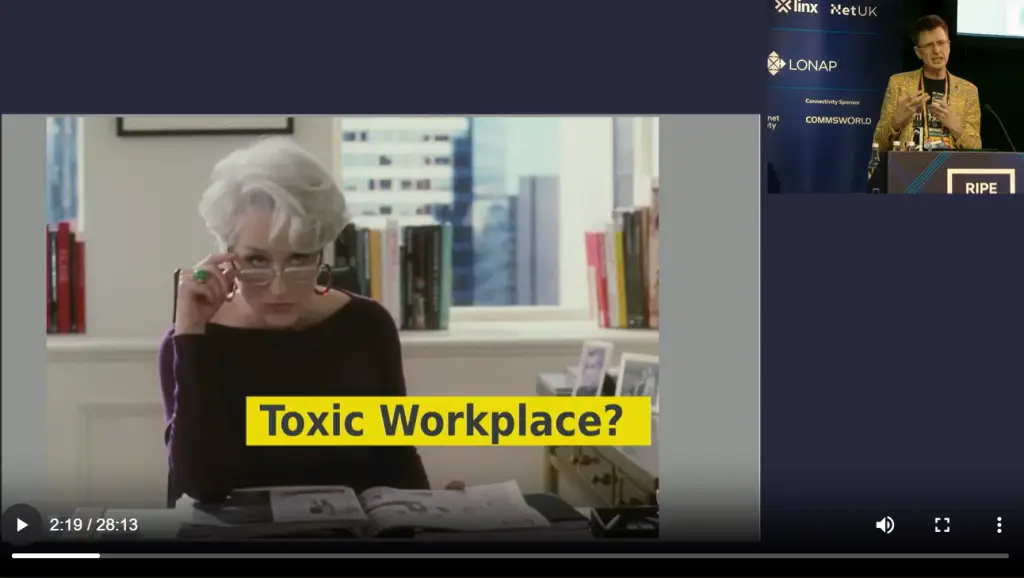
A couple of months ago I presented on Rejection Sensitivity Dysphoria (RSD) at RIPE 92 in Edinburgh. For those that don’t know, RIPE is the association of internet backbone providers for the whole of Europe, so it was quite an honour to be selected. Without RIPE, you wouldn’t be reading this!
Together with Rob Lister, we presented on RSD (Rejection Sensitive Dysphoria), which feels like this year’s hot topic. It is a strong emotional reaction to negative judgments, exclusion, or criticism from others – feeling like a failure: disproportionate to what has actually occurred.The elephant in the room is that 99% of ADHDers suffer from RSD.
I am happy to say that a free recording of that presentation is available. We dive deeper into what it is, unpack why it is so prevalent, and cover some strategies on how to deal with it.
What language says about our identity
Research papers. Can be convoluted, academic, riven with barriers and occasionally, I suspect, pure waffle to put readers to sleep, or subconsciously demonstrate power play. Not this one – it was totally engrossing and thoughtful.
Entitled “Language and terminology preferences among neurodivergent adults in the United Kingdom”, it’s about how we prefer to describe ourselves. Are you an “ADHDer” or “some with ADHD”. I know I much prefer describing myself as an ADHD, but how do you prefer someone to describe you?
Although I describe myself as an ADHDers, I am aligned with the majority of ADHDers in that I prefer non-ADHDers describing me as “a person with ADHD”. And, in this, apparently I am aligned with the majority of the ADHD population. Of course, not everyone, as that would be too easy!
The reason is this, according to the research: Many people who preferred “identity first” language view their neurodivergence as an integral part of themselves, their identity, and see it as something that cannot be removed. However there is a significant risk of the term “ADHDers” being used pejoratively by people outside the group, so “a personal with ADHD” has less baggage in that context.
It’s similar for other neurodivergencies with the exception of Tourette’s, and PDA (which this study included, and yet I wouldn’t have previously included, so I need to think more about that). For example, an autistic person is frequently happy with identifying themselves as “autistic”, but someone with Tourette’s much prefers referring to themselves as “Someone with Tourette’s”.
There was also a lot more nuance in the paper about how those with neurodivergency view the term “disabled”, which I definitely have conflicting opinions on. And it was all written in a language I could understand – maximum inclusivity points!!
It’s well worth a read if you like deep dives as it shines a mirror on how we perceive yourselves, and is written in highly accessible language. With thanks to Amy Pearson and others.
Coaching update
My diary got a little silly recently, with no space of any sort for a whole month. Some people thought my calendar had a bug, but no, automation was protecting my space. But summer is gently fading here in Scotland (where schools literally start a month before the rest of the UK), my holidays are over, my calendar has recovered, and that means there is space for one or two more coaching clients before I am again at full capacity.
One of my clients has a three week cycle, so they have two coaching sessions, a break, and then start again. This works for them, and it also shows the power of an individual approach. Between us, we can do what works for you. Interested in learning more? Book a free coaching intro call to find out!
Found this post interesting? Click “like” on LinkedIn, as this really helps me and supports my work. I write about neurodivergency matters, with a dash of inclusivity and tech. Subscribe directly to avoid missing out; you can also have a nose through my back catalogue. Want even more? You can follow me on Bluesky and/or LinkedIn.